There is something strange about the most famous scene involving Odysseus and the Sirens.
We all know what happens.
Odysseus is warned that the Sirens are dangerous. Their song is so beautiful that sailors who hear it cannot resist. They are drawn toward the sound, eventually meeting their death.
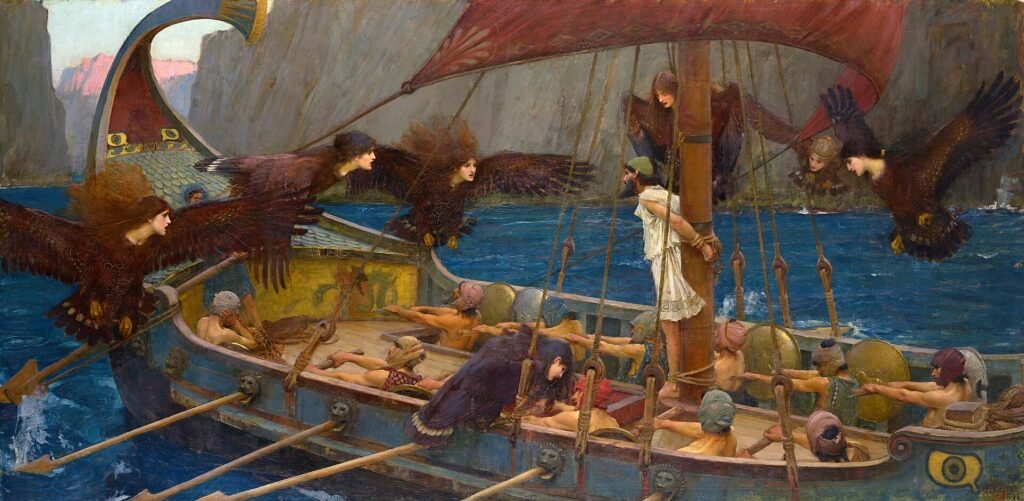
So Odysseus comes up with a clever plan. He orders his crew to tie him tightly to the ship’s mast. His men are told to block their own ears with wax and, most importantly, not to untie him no matter how desperately he begs them to do so.
Then the ship passes the Sirens.
Odysseus hears them.
And this is where the story gets interesting.
Because what, exactly, did Odysseus hear?
Was it simply a beautiful song? Was it a voice calling his name? Did the Sirens reveal some terrible secret? Or did they know exactly what to say to make a man like Odysseus completely lose control?
The original story gives us an answer—but perhaps not the complete one.
The Sirens Didn’t Just Sing
In Homer’s Odyssey, the Sirens do not simply sing a random, beautiful melody.
They speak to Odysseus.
Their song is essentially an invitation. They call him by name and appeal to his reputation as the famous hero of the Trojan War. They claim to know what happened at Troy and suggest that they possess knowledge that others do not.
That detail is easy to overlook.
The Sirens’ power isn’t only their voices.
It is knowledge.
They are offering Odysseus something he desperately wants: answers.
And think about who Odysseus is.
This is a man who spends years trying to get home. He has survived wars, monsters, storms, gods, giants, and countless other dangers. He is famously curious and clever. He wants to understand things. He wants to know what lies ahead.
So imagine being Odysseus and hearing a voice say, in effect:
Come closer. We know what happened. We know the things you want to know.
Wouldn’t you listen?
The Most Important Part: They Know Who He Is
There is another detail that makes the scene even more interesting.
The Sirens recognize Odysseus.
They don’t speak to him like an ordinary sailor.
They know his name and his reputation.
They know about the Trojan War and his journey. They understand that he is the kind of man who would be tempted by the promise of knowledge.
That makes their song feel much more personal.
The Sirens aren’t simply saying, “Come here, sailor.”
They’re saying, essentially, “Odysseus, we know you.”
And perhaps that is what makes the scene so disturbing.
The greatest danger isn’t always something that attacks you.
Sometimes, it is something that understands exactly what you want.
So What Did Odysseus Actually Hear?
Homer doesn’t give us a full transcript of every word the Sirens sang.
Instead, we get the general meaning of their message.
They promise Odysseus knowledge through their song. They tell him that those who pass them hear their beautiful voice, and they suggest that they know the events of the Trojan War and what has happened throughout the world.
In other words, their temptation is not simply:
“Come here because our song is beautiful.”
It is closer to:
“Come here because we can tell you things nobody else can.”
And that changes the entire scene.
The song isn’t just music.
It’s information disguised as temptation.
But Here Is the Interesting Question
What if the Sirens were telling the truth?
This is where the story becomes perfect for an open discussion.
Maybe the Sirens really did know things that Odysseus didn’t.
Maybe they really could tell him the future.
Maybe they could reveal secrets about the gods, his journey, his enemies, or even his home in Ithaca.
The story never needs to confirm exactly how much they knew.
The temptation works because Odysseus believes they might know.
And that uncertainty is powerful.
Imagine hearing a voice that promises answers to every question you’ve been carrying for years.
Would you really want to keep sailing?
Why Was Odysseus Tied Up?
This is probably the most famous part of the story.
Odysseus knows himself well enough to understand that simply being warned about the Sirens won’t be enough.
He doesn’t trust his future self.
So he creates a situation where his crew can protect him from his own decisions.
That is surprisingly human.
He knows that when he hears the Sirens, he may change his mind.
He may demand to be released.
He may scream at his crew.
He may promise that everything will be fine.
And that’s exactly what happens.
As the ship gets closer, Odysseus becomes desperate to be released. He gestures and commands his men to untie him, but they follow his earlier instructions and tighten the ropes instead.
The cleverest man on the ship has essentially trapped himself.
And perhaps that is the real point of the scene.
Odysseus doesn’t defeat temptation by becoming stronger.
He defeats it by planning for the moment when he won’t be strong enough.
What Did the Song Sound Like?
This is something the ancient text leaves surprisingly open.
Homer tells us about the Sirens’ words and their beautiful voices, but we don’t get a musical description in the modern sense.
We don’t know the melody.
We don’t know whether it was soft, haunting, powerful, comforting, or almost supernatural.
That leaves a huge amount of room for interpretation.
And if The Odyssey brings this scene to the screen, this could become one of the most fascinating creative decisions in the entire movie.
What should the audience hear?
A beautiful song?
A whisper?
A familiar voice?
The voices of people Odysseus has lost?
Or perhaps something that sounds different to every person who hears it?
That last possibility is especially interesting.
Maybe the Sirens don’t have one song.
Maybe they sing whatever their listener most desperately wants to hear.
Perhaps the Sirens Didn’t Need to Lie
There is another way to look at the scene.
The Sirens might not need to invent anything.
They could simply tell Odysseus things he already wants to believe.
After years away from Ithaca, perhaps what he wants most is reassurance that his journey has meaning.
Perhaps he wants to hear that he is still remembered.
Perhaps he wants to know that his wife is waiting for him.
Perhaps he wants answers about the future.
Or perhaps, after everything he has survived, he simply wants someone to tell him that he is the greatest hero alive.
The Sirens understand desire.
That may be their real power.
The Real Horror of the Sirens
We often think of the Sirens as monsters because they kill sailors.
But their story is more interesting than that.
They don’t need to chase anyone.
They don’t need weapons.
They don’t even need to force their victims.
They simply offer something irresistible.
For Odysseus, that something is knowledge.
And that’s why the story has survived for thousands of years.
Because the Sirens are not only creatures from Greek mythology. They represent a very human weakness: the desire to know what we are not supposed to know.
What if someone told you they could answer every question you have ever had?
Would you walk away?
Odysseus couldn’t.
He had to be tied to a mast just to make sure he could.
And perhaps that’s the most revealing answer to the question of what Odysseus actually heard.
He heard more than a song.
He heard a promise.
A promise of knowledge, answers, and perhaps a glimpse of everything he had been searching for.
And for a man like Odysseus, that may have been the most dangerous sound in the world.
What Would Your Sirens Sing?
Homer didn’t write a simple fairytale about scary monsters by the sea. He gave us a timeless warning about the traps we build around our own deepest desires.
Odysseus didn’t survive because he was immune to temptation. He survived because he was honest enough to admit that, when the moment came, he might not be strong enough to resist it on his own.
And that leaves us with a question that goes far beyond ancient Greek poetry or even a modern movie adaptation.
If the Sirens could create a song specifically for you—one that promised exactly what you crave most, whether that’s complete control, total peace, fame, wealth, or the answers to your deepest questions—what would they sing?
What would they promise you to make you let go of everything else?
And perhaps the more important question is this: what are your “ropes”?
What are the things, people, principles, or boundaries you rely on to keep yourself from going too far when temptation takes over?
Odysseus had his crew and the ropes around the mast.
What do you have?
- Let’s open this up in the comments below. What do you think your Sirens would sing?